

By Bridget Nielsen, Sedona spiritual artist, intuitive healer, and retreat facilitator | 10/6/26
Today, so much emphasis is placed on talk therapy to untangle our mental frenzy. We wait for the perfect quiet for a deep meditation or spiritual insight that often doesn’t come. We yearn for a lifestyle or awe-inspiring form of expression that we only dream of experiencing from behind a screen.
Why Eastern Medicine Looks at Heat in the Head
In Eastern medicine, from a simplified vantage, health depends on whether there is more heat in the head or in the lower body (the dantian, or Hara). When excess heat or energy accumulates in the head, disease can follow.
Unfortunately, this is where Western culture tends to live: in the mind, in concepts, and in chaotic flurry.
“Are You Painting?” A Question That Changes the Direction
A recent phrase softened everything for me, as a solution to the noise:
“Are you painting?”
This literal question, and the broader analogy behind it, beckons us to create in whatever form that takes: music, art, gardening, cultivating friendships. This reorientation turns the current toward what the East would define as wellness.
Are you moving energy out of your head and through your creative center, called the Hara in Japan (located in the lower abdomen, around the sacral chakra or womb), inviting it downward?
Often, the remedy for our challenges and angst is found in simplicity. The solution may not be easy to face, but resolution arrives when we step back and become a vessel of flow, with the divine within us in action.
Admittedly, one of the great flaws of New Age spirituality, and of modern life behind a screen, is stopping at intention or wishful thinking and living solely in the energetic unmanifest. It’s a trap I sometimes fall into myself. It misses the physicalization needed to make things manifest, and the spiritual principle that you are a creator!
So create! Paint, write, dance, rap, knit!
What Research Says About Making Things With Your Hands
The science now echoes what our ancestors knew and, out of necessity, lived. In a Mayo Clinic study of nearly 2,000 older adults, those who regularly did crafts like pottery, quilting, and sewing had a 28% lower risk of developing mild cognitive impairment over four years (Krell-Roesch et al., 2017). The study shows an association, not proof of cause and effect.
Meanwhile, AI use is on the rise. Early, not-yet-peer-reviewed research from MIT found that people who used AI to help write essays showed weaker brain connectivity and felt less ownership of their work than those who wrote unaided (Kosmyna et al., 2025). As technology accelerates, handwork and physical crafts may become an increasingly important way to strengthen brain connectivity and mental wellness.
When we use our hands and bodies, wonderful things happen for our minds and bodies. In a 2016 art therapy study, participants’ cortisol levels dropped after 45 minutes of art making, and prior art experience made no difference (Kaimal et al., 2016).
Moving Energy From Head to Hands
The palm chakras within our hands are an extension of our lower creative center, so using our hands moves excess energy from the head down to the dantian (Hara). Through that, we create internal harmony, a calmer mind, and true wellness.
This isn’t new. Our ancestors filled their days crafting their lives into reality with their bare hands. There’s satisfaction in it, not to mention a gratifying reward response and the reflected feedback of their actualized creatorship. What you DO, MATTERS. It becomes matter. Empowering and enlivening.
My Own Return to Painting
Over the past year, life has asked a lot of me. My refuge in deep challenge was getting my hands dirty on our renovation projects and picking up my paintbrush again. When grief, project timeline pressures, and endless details seemed to invade my inner sanctum, a knowing serenity would emerge fairly quickly once I let myself get lost in a drawing or new painting.
I had set down my physical creations for about a decade while my online career soared on YouTube. I was grateful for the “excuse” to paint for our home and rental properties. In my experience, crafting for the internet is satisfying, but creating in real life is deeply fulfilling. It hits a different note of knowing and harmony that stirs my soul.
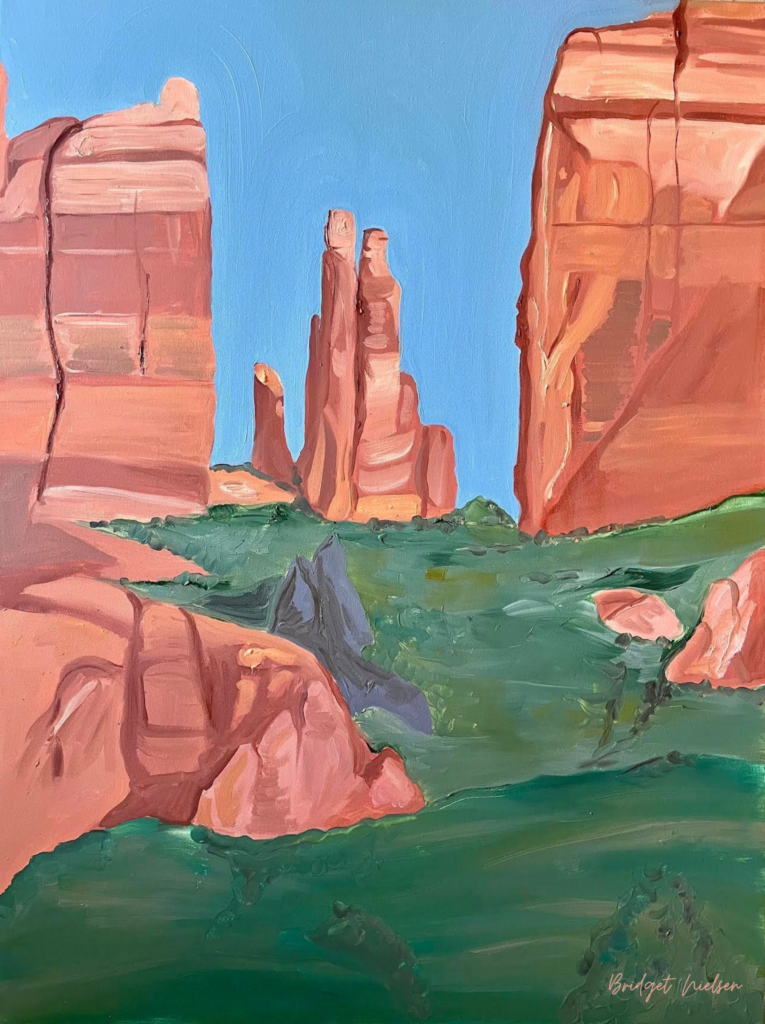
Here are a couple of paintings from the past year. Some are still in process, but I like seeing and sharing the journey of art.

How to Move From Scrolling to Creating
This invitation to move from head to hands, and from the digital to the physical world, is no small ask. I’ve heard a lot lately about how millennials stand on the cusp between the pre-digital and post-digital worlds. When I was 16, I spent 20 hours at my dining room table hand-drawing Grace Kelly’s face for a school project. You can only play Mario Kart and text your friends so many times, so I found other interests that drew my attention away from the screen. I forged and cultivated “real reality” skills that help me today move my will from scrolling to form.
It’s still challenging, especially when you’re venturing into an exciting but new skill. I recommend taking an in-person class or joining a group to help with the learning curve and build physical momentum. Our will needs support in these times.
Opting for analog is a great step. I wrote this note by hand at a bustling Middle Eastern coffee shop, sipping a hot cardamom mint tea.
Our spirits and equilibrium are fed, nourished, and balanced by actualizing our creatorship. Creative acts of embodiment cultivate wellness and wholeness. They are simple, healing balms that restore peace in frenzy and calm in chaos.
I’d love to hear what you’re creating. Please comment and share below!
So, are you painting? What are you making with your hands this week?
Frequently Asked Questions
Does making art reduce stress?
In one 2016 study, cortisol dropped in most participants after 45 minutes of art making, whether or not they had prior experience. The sample was small (39 adults), so more research is needed.
Can crafts help protect the brain as we age?
A Mayo Clinic study linked regular craft activity to a 28% lower risk of mild cognitive impairment. It’s observational, so it shows an association, not proof that crafting prevents decline.
What is the dantian?
In Chinese medicine and qigong, the dantian is an energy center in the lower abdomen, below the navel. The Japanese equivalent is often called the Hara.
What can I make if I’m not “artistic”?
Anything counts: gardening, knitting, cooking, journaling by hand, or building something. In the cortisol study, prior art experience made no difference.
Bridget Nielsen is a Sedona-based retreat facilitator, spiritual artist, muralist, intuitive healer, and host of the Wild & Awake podcast. She has led more than 50 retreats worldwide over 15+ years, specializing in women’s embodiment and circles, and is passionate about bringing people together in person for connective experiences of humanity.
Sources
- Krell-Roesch, J., et al. (2017). Association between mentally stimulating activities in late life and the outcome of incident mild cognitive impairment. JAMA Neurology. [add PubMed link]
- Kosmyna, N., et al. (2025). Your Brain on ChatGPT: Accumulation of cognitive debt when using an AI assistant for essay writing task. MIT Media Lab (preprint).
- Kaimal, G., Ray, K., & Muniz, J. (2016). Reduction of cortisol levels and participants’ responses following art making. Art Therapy.